Author Event! Robert J. Sampson’s “Marked by Time”
Evento con el autor Robert J. Sampson: Marcado por el tiempo
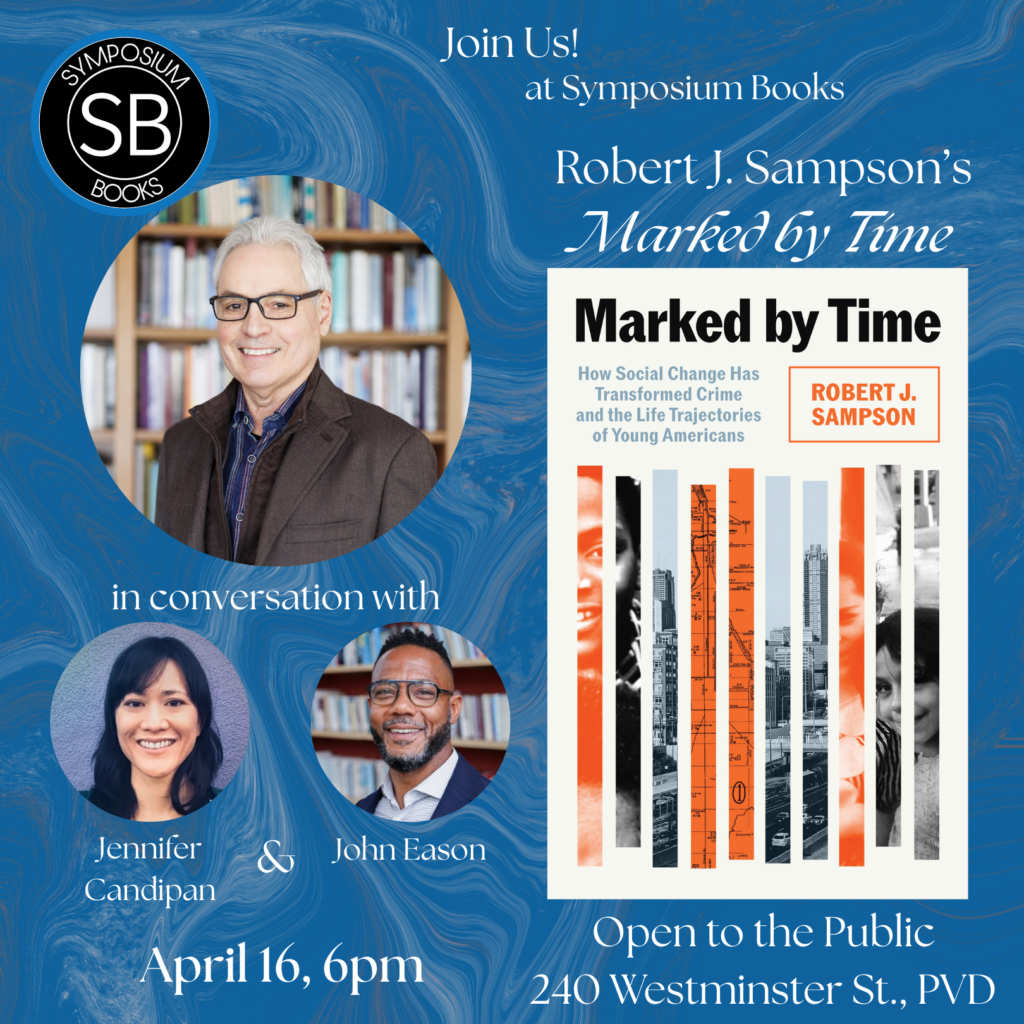
Join us on April 16th at 6pm as we host Robert J. Sampson in conversation with Jennifer Candipan and John Eason to discuss his new book, Marked by Time: How Social Change Has Transformed Crime and the Life Trajectories of Young Americans. Signed copies of the book will be available for purchase!
About the Book:
A leading sociologist’s groundbreaking three-decade study challenges outdated views of crime and character, revealing that traditional risk factors alone poorly predict children’s futures.
Between 1970 and 2020, the United States experienced a dramatic rise in crime and incarceration, followed by an unexpected decline. Along with plummeting violence came reductions in substance use, car accidents, child poverty, and lead exposure. By 2020, incarceration rates hit a twenty-five-year low, with African Americans benefiting the most. Yet these positive shifts have not registered in public discourse or policies, which continue to rely on outdated studies and reductive narratives of moral character and personal responsibility.
A major reason for this oversight is how social scientists study youth development—typically through single-birth-cohort approaches that fail to capture generational change. In a pioneering three-decade study of over one thousand Chicago children across multiple cohorts, Robert J. Sampson challenges this convention. He finds that children with similar self-control and family backgrounds, born just a decade apart, experienced dramatically different life paths. Strikingly, children born in the mid-1980s faced twice the likelihood of arrest by their mid-twenties than those born ten years later.
This research reframes deeply ingrained assumptions about ongoing social decline and the importance of individual fortitude. Sampson spotlights the role of shifting social conditions and structural change in driving measurable improvements in youth trajectories, along with new risks that threaten these gains.
The era into which a child is born shapes their future as profoundly as race, upbringing, or neighborhood. To rethink progress, inequality, and policy, we must first acknowledge how time itself leaves a transformative mark on individual lives.
About the Author:
Robert J. Sampson teaches at Harvard University, where he is the Woodford L. and Ann A. Flowers University Professor. He is also an Affiliated Research Professor at the American Bar Foundation, founding director of the Boston Area Research Initiative, and Scientific Director of the ongoing Project on Human Development in Chicago Neighborhoods (PHDCN+). He taught previously at the University of Chicago.
Professor Sampson is an elected member of the National Academy of Sciences and a Fellow of the American Academy of Arts and Sciences, the American Philosophical Society, the American Society of Criminology, the American Academy of Political and Social Science, the John Simon Guggenheim Foundation, and, as Corresponding Fellow, the British Academy. He is the former President of the American Society of Criminology and in 2011 he received the Stockholm Prize in Criminology.
His research and teaching cover a variety of areas including crime and criminal justice, the life course and social change, neighborhood effects, collective civic engagement, inequality, and urban social structure. He is the author of numerous articles and multiple award-winning books, including Great American City: Chicago and the Enduring Neighborhood Effect (2nd edition, 2024), published by the University of Chicago Press. His newest book was published in February 2026 from the Belknap Press of Harvard University Press: Marked by Time: How Social Change Has Transformed Crime and the Life Trajectories of Young Americans.
About the Moderators:
Jennifer Candipan is the Stanley J. Bernstein Assistant Professor of Sociology at Brown University and a faculty affiliate at Brown’s Population Studies and Training Center, Spatial Structures for the Social Sciences, Annenberg Institute, and Urban Studies Program. In 2019-20, she was a Postdoctoral Research Fellow in the Department of Sociology at Harvard University.
Her broad research and teaching interests are in stratification, urban sociology, race/ethnicity, and sociology of education. Her work is guided more generally by understanding connections between people and places, with a research agenda that broadly investigates the dynamics of neighborhood and urban change and inequality, as well as how social and spatial contexts, like neighborhoods and schools, shape opportunity and produce racial/ethnic, health, and economic inequality. Her research has been funded by the National Science Foundation, National Institutes of Health, Spencer Foundation, National Academy of Education, and Russell Sage Foundation, among others.
John Eason is an associate professor of sociology and international and public affairs at Brown University. He holds a Ph.D. in sociology from the University of Chicago. Eason, a native of Evanston, Illinois, received a bachelor’s degree in Urban and Regional Planning from the University of Illinois Urbana-Champaign and a M.P.P. from the Harris School of Public Policy at the University of Chicago.
Before entering graduate school, Eason was a church-based community organizer focused on housing and criminal justice issues. He also served as a political organizer for then-Illinois State Senator Barack Obama.
Eason’s research interests challenge existing models and develop new theories of community, health, race, punishment and rural/urban processes in several ways. First, by tracing the emergence of the rural ghetto, he establishes a new conceptual model of rural neighborhoods. Next, by demonstrating the function of the ghetto in rural communities, he extends concentrated disadvantage from urban to rural community process. These relationships are explored through his book, Big House on the Prairie: Rise of the Rural Ghetto and Prison Proliferation (University of Chicago Press).
Acompáñanos el 16 de abril a las 6 pm mientras recibimos a Robert J. Sampson en conversación con Jennifer Candipan y John Eason para discutir su nuevo libro, Marcado por el Tiempo: Cómo el Cambio Social ha Transformado el Crimen y las Trayectorias de Vida de los Jóvenes Estadounidenses. ¡Habrá copias firmadas del libro disponibles para la compra!
Acerca del Libro:
El estudio innovador de tres décadas de un sociólogo líder desafía las visiones anticuadas sobre el crimen y el carácter, revelando que los factores de riesgo tradicionales por sí solos predicen pobremente el futuro de los niños.
Entre 1970 y 2020, Estados Unidos experimentó un aumento dramático en el crimen y la encarcelación, seguido por un descenso inesperado. Junto con la caída de la violencia, se redujeron el consumo de sustancias, los accidentes automovilísticos, la pobreza infantil y la exposición al plomo. Para 2020, las tasas de encarcelamiento alcanzaron un mínimo en veinticinco años, beneficiando principalmente a los afroamericanos. Sin embargo, estos cambios positivos no se han reflejado en el discurso público ni en las políticas, que continúan basándose en estudios obsoletos y narrativas reductivas sobre el carácter moral y la responsabilidad personal.
Una razón importante para esta omisión es cómo los científicos sociales estudian el desarrollo juvenil—típicamente a través de enfoques de cohortes de nacimiento únicas que no capturan el cambio generacional. En un estudio pionero de tres décadas con más de mil niños de Chicago de múltiples cohortes, Robert J. Sampson desafía esta convención. Encuentra que niños con autocontrol y antecedentes familiares similares, nacidos con solo una década de diferencia, experimentaron trayectorias de vida dramáticamente diferentes. Sorprendentemente, los niños nacidos a mediados de los años 80 enfrentaron el doble de probabilidad de ser arrestados antes de los veinticinco años que aquellos nacidos diez años después.
Esta investigación replantea suposiciones profundamente arraigadas sobre el declive social continuo y la importancia de la fortaleza individual. Sampson destaca el papel de las condiciones sociales cambiantes y el cambio estructural en la conducción de mejoras medibles en las trayectorias juveniles, junto con nuevos riesgos que amenazan estos avances.
La época en que un niño nace moldea su futuro tan profundamente como la raza, la crianza o el vecindario. Para repensar el progreso, la desigualdad y la política, primero debemos reconocer cómo el tiempo mismo deja una marca transformadora en las vidas individuales.
Acerca del Autor:
Robert J. Sampson enseña en la Universidad de Harvard, donde es Profesor Universitario Woodford L. y Ann A. Flowers. También es Profesor de Investigación Afiliado en la American Bar Foundation, director fundador de la Boston Area Research Initiative y Director Científico del proyecto en curso Project on Human Development in Chicago Neighborhoods (PHDCN+). Anteriormente enseñó en la Universidad de Chicago.
El profesor Sampson es miembro electo de la Academia Nacional de Ciencias y Fellow de la American Academy of Arts and Sciences, la American Philosophical Society, la American Society of Criminology, la American Academy of Political and Social Science, la John Simon Guggenheim Foundation y, como Corresponding Fellow, de la British Academy. Fue presidente de la American Society of Criminology y en 2011 recibió el Premio de Estocolmo en Criminología.
Su investigación y enseñanza abarcan diversas áreas, incluyendo crimen y justicia penal, el curso de vida y cambio social, efectos vecinales, compromiso cívico colectivo, desigualdad y estructura social urbana. Es autor de numerosos artículos y varios libros galardonados, incluyendo Great American City: Chicago and the Enduring Neighborhood Effect (2ª edición, 2024), publicado por la University of Chicago Press. Su libro más reciente fue publicado en febrero de 2026 por Belknap Press de Harvard University Press: Marked by Time: How Social Change Has Transformed Crime and the Life Trajectories of Young Americans.
Acerca de los Moderadores:
Jennifer Candipan es Profesora Asistente Stanley J. Bernstein de Sociología en la Universidad de Brown y afiliada en el Population Studies and Training Center, Spatial Structures for the Social Sciences, Annenberg Institute y Urban Studies Program de Brown. En 2019-20, fue investigadora postdoctoral en el Departamento de Sociología de la Universidad de Harvard.
Sus amplios intereses de investigación y enseñanza incluyen estratificación, sociología urbana, raza/etnicidad y sociología de la educación. Su trabajo se guía más generalmente por comprender las conexiones entre personas y lugares, con una agenda de investigación que investiga ampliamente la dinámica del vecindario y el cambio urbano y la desigualdad, así como cómo los contextos sociales y espaciales, como vecindarios y escuelas, moldean las oportunidades y producen desigualdad racial/étnica, de salud y económica. Su investigación ha sido financiada por la National Science Foundation, National Institutes of Health, Spencer Foundation, National Academy of Education y Russell Sage Foundation, entre otros.
John Eason es profesor asociado de sociología y asuntos internacionales y públicos en la Universidad de Brown. Tiene un doctorado en sociología de la Universidad de Chicago. Eason, originario de Evanston, Illinois, obtuvo una licenciatura en Planificación Urbana y Regional de la University of Illinois Urbana-Champaign y una Maestría en Políticas Públicas de la Harris School of Public Policy de la Universidad de Chicago.
Antes de ingresar a la escuela de posgrado, Eason fue organizador comunitario basado en la iglesia enfocado en temas de vivienda y justicia penal. También trabajó como organizador político para el entonces senador estatal de Illinois Barack Obama.
Los intereses de investigación de Eason desafían los modelos existentes y desarrollan nuevas teorías sobre comunidad, salud, raza, castigo y procesos rurales/urbanos de varias maneras. Primero, al rastrear la aparición del gueto rural, establece un nuevo modelo conceptual de vecindarios rurales. Luego, al demostrar la función del gueto en comunidades rurales, extiende la desventaja concentrada desde el proceso comunitario urbano al rural. Estas relaciones se exploran a través de su libro, Big House on the Prairie: Rise of the Rural Ghetto and Prison Proliferation (University of Chicago Press).
Related Events
Eventos relacionados